
As artificial intelligence becomes a more common tool for scientists, a major concern is that the diverse landscape of research topics and approaches may collapse into a narrow set of questions best probed through AI. We risk cornering ourselves with a single tool that severely biases the work we do and the solutions we find—especially when that technology is trained mostly on data limited to what humans can already perceive. However, training automated agents to perform tasks also provides an opportunity to build technology that is genuinely complementary to humans, not just redundant but faster. The nice thing about computers is that we can feed them data from sources richer than our own senses.
This project is an attempt at exactly that goal for geologists. A huge part of geological work involves looking at a rock and identifying what kinds of minerals, shells, or grains exist in it, and how big they are. Human eyes and brains are remarkably good at this task, but they’re slow, and they don’t capture all the information that minerals give off—particularly outside the visible spectrum. That gap is why I designed a new multispectral camera system that images rock samples across eight color bands, from blue light through near-infrared, plus ultraviolet fluorescence.
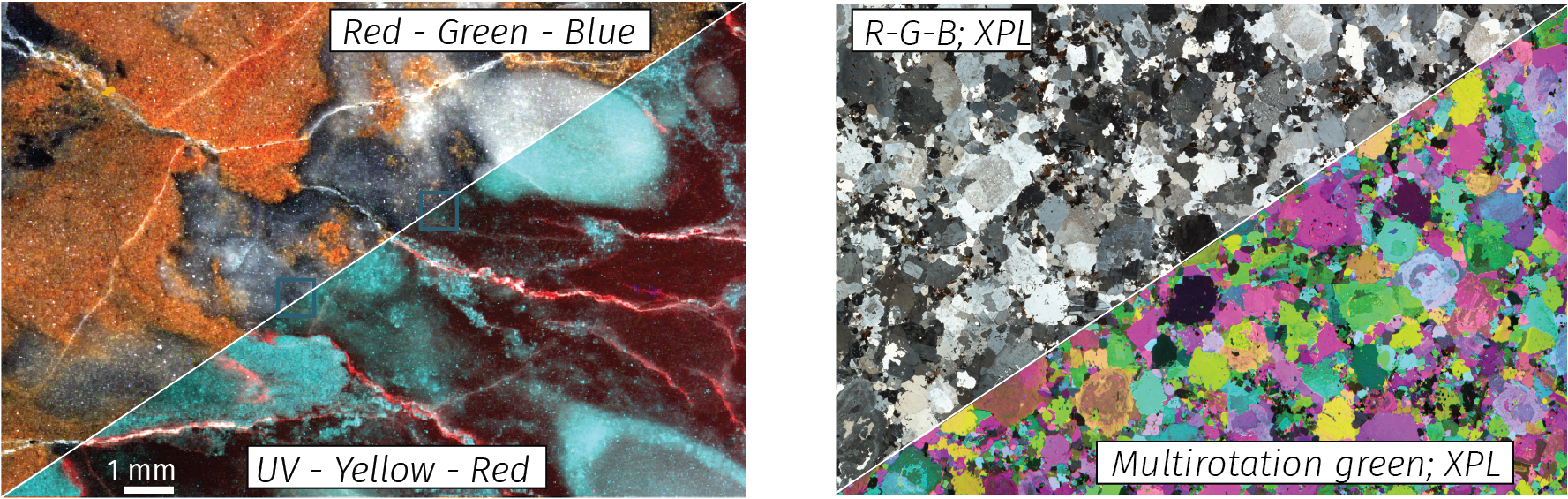
By capturing spectral properties that our eyes simply can’t see, this system heightens contrast between rock features and dramatically improves the accuracy of machine learning models trained to classify them. The goal isn’t to replace the geologist’s eye, but to give it superpowers. In future work, we’ll pair this high-resolution imaging with automated analysis so that the same samples collected for geochemical work can also yield rich, reproducible petrographic data for deeper geophysical insights.